


The DFW housing market has cooled considerably since the red-hot days of the pandemic era. But it hasn’t fully shifted into “buyer’s market” territory (yet).
But could that change in 2026? Could Dallas become a buyer’s market in late 2026 or early 2027? Read on to find out why that’s plausible…
Five things to know right up front:
The Dallas-Fort Worth housing market is no longer as seller-friendly as it was during the pandemic boom.
Inventory has been rising steadily, giving buyers more options and easing competition.
Homes are taking longer to sell, putting more pressure on sellers.
Most analysts still classify DFW as a balanced market in spring 2026, rather than a buyer’s market.
But this could change over the coming months, especially if inventory continues to grow and mortgage rates stay elevated.
A Housing Market in Transition
In 2026, the market looks noticeably different than it did during the pandemic-era housing boom. Buyers have more homes to choose from, while sellers have more competition.
Some data points to support that statement:
According to Redfin data, DFW currently has about a 5-month supply of homes for sale, up from a 2-month supply five years ago.
The typical DFW home currently stays on the market about 20 days longer than the national median time on market.
According to a Realtor.com report, the Dallas-area housing market is “early balanced,” meaning it no longer favors sellers.
A March 2026 report from Zillow reported: “The average Dallas-Fort Worth-Arlington home value is $364,734, down 3.7% over the past year.”
Some major housing platforms now describe the DFW market as balanced, meaning neither buyers nor sellers have a clear advantage.
But that raises a bigger question:
Is Dallas-Fort Worth on the verge of becoming a buyer’s market, maybe later in 2026 or in early 2027?
To answer that, we have to determine what a “buyer’s market” is—and how close the DFW area is to meeting that definition.
What Is a Buyer’s Market?
In simple terms, a buyer’s market occurs when housing supply exceeds demand.
That imbalance gives buyers more leverage in the transaction.
Common signs of a buyer’s market include:
More homes for sale than buyers actively shopping
Longer time on market (homes sitting unsold)
Increased price reductions
More negotiating power for buyers (closing costs, repairs, concessions)
A commonly used benchmark is months of supply:
0–3 months: Seller’s market
4–5 months: Balanced market
6+ months: Buyer’s market
(For context: The DFW had about a 5-month supply of homes in spring 2026.)
Dallas Has Cooled, But Not Yet a Buyer’s Market
Most recent data suggests Dallas-Fort Worth is currently hovering in the balanced range, not fully in buyer territory.
But this could change going forward. If the market continues cooling, with increased supply and reduced demand, we could see a DFW buyer’s market later in 2026 or in early 2027.
Here are some of the trends we’ll want to monitor going forward, to track this shift:
Trend #1: Inventory Is Rising in the DFW Area
Rising inventory is one of the clearest trends shaping the Dallas-area real estate market.
Compared to the ultra-tight conditions of 2021–2022, there are now significantly more homes available for sale across North Texas.
This shift is happening for a few key reasons:
1. More New Construction
Texas is one of the most active home-building regions in the country. That construction pipeline puts a steady stream of new homes into the market, particularly in suburban areas around Dallas and Fort Worth.
2. Reduced Buyer Demand
Mortgage rates continue to hover well above pandemic lows, currently averaging above 6% for a 30-year fixed mortgage. That has reduced affordability and pulled some buyers out of the market, slowing demand.
3. Homes Taking Longer to Sell
During the boom, DFW real estate listings would disappear in days. Now, homes are sitting on the market for much longer, allowing inventory to accumulate over time.
Trend #2: Homes Are Taking Longer to Sell
We can see another important shift in the median “days on market” (DOM) metric.
In a hot seller’s market, homes tend to sell quickly—often within days and sometimes with multiple offers.
But in today’s DFW housing market:
Homes are taking longer to sell than in previous years.
Buyers have more time to carefully consider their options.
The FOMO urgency that defined the pandemic era has mostly faded.
This change has a direct impact on market dynamics.
When homes sit longer:
Sellers are more likely to reduce their list prices.
Buyers gain bargaining power over sale price, concessions, etc.
The market begins to feel more “normal” rather than frenzied.
These kinds of trends reflect a housing market that has shifted away from seller dominance and toward more buyer-friendly conditions. That’s the situation in Dallas and much of Texas.
Trend #3: Prices Have Declined
Home prices can give us additional clues as to where a housing market might be headed.
And in the Dallas area, price trends show just how much the market has cooled over the past few years.
Realtor․com, Zillow, and Redfin all report a decline in DFW home prices over the past year, falling by an average of around 2% (across all sources).
The following graph shows the median home value for the Dallas-Fort Worth metroplex going back several years, based on Zillow data.
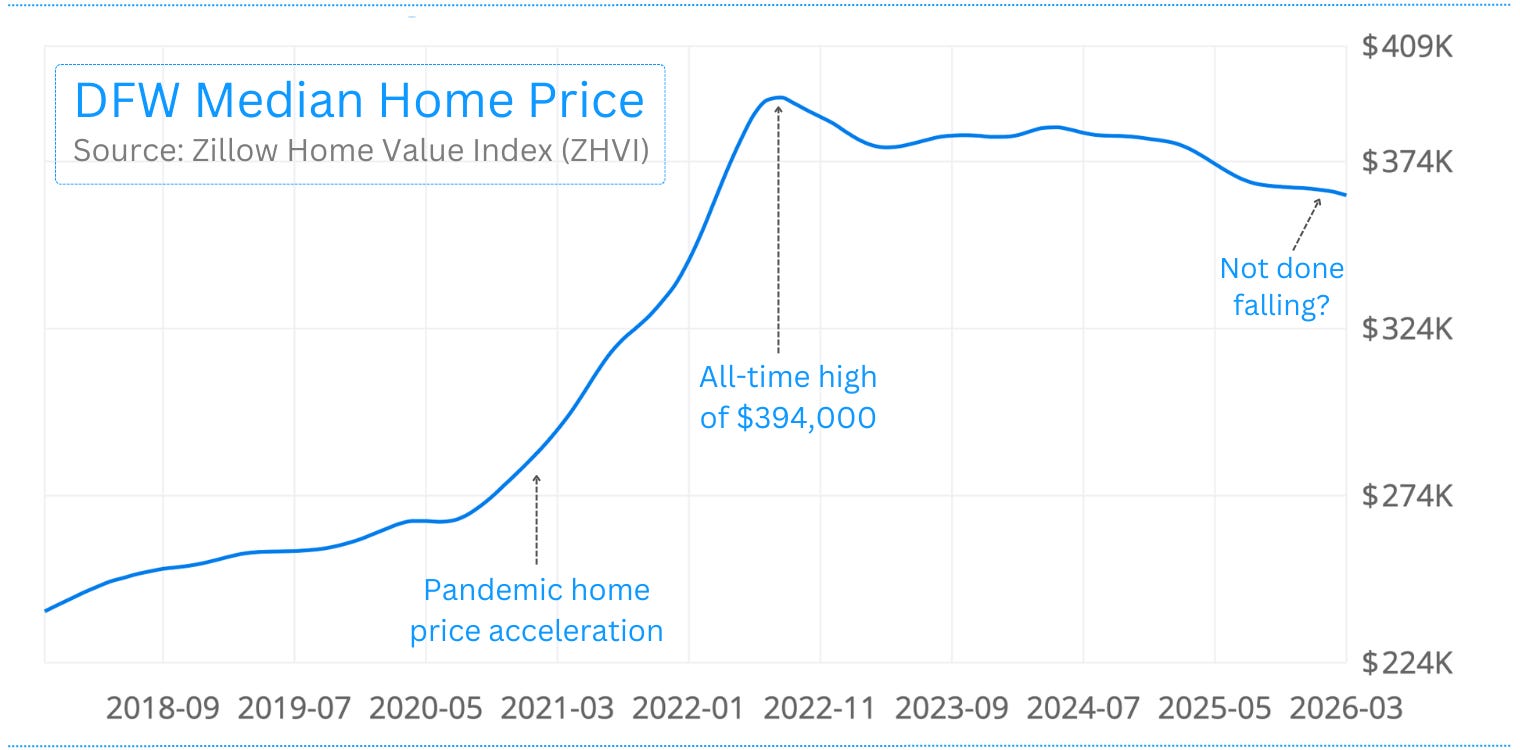
As you can see, DFW-area home prices rose to an all-time high in late 2022, but have either been flatlining or declining ever since.
By themselves, falling prices don’t signal that a buyer’s market is imminent. But they do provide additional evidence of a cooling market that might flip toward buyers in the near future.
What Would Push DFW Into a Buyer’s Market?
No one can predict future real estate trends with complete accuracy. But the current picture suggests that DFW could become more buyer-friendly later in 2026.
But for the Dallas-Fort Worth housing scene to fully shift into a true buyer’s market, one or more of the following would likely need to happen:
1. Continued Inventory Growth
If new listings keep coming onto the market, it could push DFW toward buyer’s market territory. We could see a scenario like this if (A) new construction remains strong and (B) sellers continue listing their homes at the current pace.
2. Sustained Weak Demand
Mortgage rates play a big role in all of this. If borrowing costs stay elevated (or rise further), affordability will limit buyer activity. Fewer buyers = more supply relative to demand. When pushed to the extreme, this can create a buyer’s market fairly quickly.
3. Increasing Price Reductions
As homes sit on the market for longer periods (as they are in 2026), sellers typically begin cutting their prices more aggressively. When these reductions become widespread over time, it can give buyers the upper hand.
4. Economic Slowdown (Wildcard Scenario)
A broader economic slowdown including job losses and/or a full-blown recession could significantly weaken demand. We often see real estate markets shift toward buyers in such times. That scenario seems unlikely in spring 2026, but it’s a future possibility.
A “Soft” Buyer’s Market From 2026 to 2027?
A full-blown Dallas area buyer’s market doesn’t appear to be on the near horizon. But there’s a more likely shift that could occur over the coming months, involving a “soft” buyer’s market.
In fact, DFW seems to be headed in that very direction in 2026.
This kind of scenario would involve:
Inventory slightly above balanced levels.
Buyers having more negotiating power.
Longer time on market, especially for underprepared or overpriced homes.
Home prices dipping further, but probably not by much.
If the current shift continues (and especially if mortgage rates rise further), we could see this kind of soft buyer’s market emerge in the second half of 2026 and carry into 2027.
The Dallas-Fort Worth housing market hasn’t fully tipped into a buyer’s market yet. But with inventory rising, homes taking longer to sell, and demand constrained by higher rates, it’s clearly moving closer to that threshold.